
The AE Trust Gap: Why Co-Sell Readiness Isn’t Enough
Every ecosystem leader has seen this play out. A partner checks all the boxes: packaged use cases, defined ICPs, certifications, even a few early co-sell motions. On paper, they’re ready. But in the field, nothing happens. AEs hesitate. Pipeline doesn’t move. The partner wonders why all that enablement never turned into deals.
The issue isn’t readiness. It’s trust.
Co-sell readiness gets a partner eligible. Trust gets them invited.
Every ecosystem leader has seen this play out. A partner checks all the boxes: packaged use cases, defined ICPs, certifications, even a few early co-sell motions. On paper, they’re ready. But in the field, nothing happens. AEs hesitate. Pipeline doesn’t move. The partner wonders why all that enablement never turned into deals.
The issue isn’t readiness. It’s trust.
Co-sell readiness gets a partner eligible. Trust gets them invited.
What actually builds AE trust
Across SaaS ecosystems, four factors consistently determine whether AEs engage a partner in real deals:
1. Proof of execution
Certifications signal capability, but execution creates belief. Five to ten visible joint wins matter far more than a long list of badges. Once AEs see a partner succeed in real accounts, momentum builds quickly.
2. Clear, deal-level outcomes
AEs don’t sell frameworks or features. They sell outcomes: reduced risk, faster cycles, revenue expansion. Partners that can explain their impact in one breath—what changed, by how much, and why it mattered—earn credibility faster than those relying on generic positioning.
3. Executive sponsorship
Partners backed by regional or segment leadership don’t wait to be discovered. When VPs or RVPs advocate for a partner, AEs interpret that as a signal that engagement is safe, supported, and worthwhile.
4. Field visibility
Trust spreads socially. Internal referrals, win wires, and shared calls make partners visible beyond a single deal team. When AEs hear about a partner from peers—not just partner managers—adoption accelerates.
Why the data supports this
Sales teams consistently report hesitancy engaging unfamiliar partners without a clear path to a win. Partners with active AE advocacy close materially more joint deals than those without. In practice, even a small number of referenceable wins can shift a partner from ignored to indispensable, unlocking outsized increases in field referrals.
What vendors should do differently
1. Measure trust, not just readiness
Readiness scores show preparation. Trust signals show adoption. Track AE referrals, repeat invitations, and leadership sponsorship alongside certifications and enablement completion.
2. Equip AEs with usable proof points
Replace abstract messaging with outcome-driven language AEs can use immediately in customer conversations.
3. Amplify trusted partners visibly
Highlight partners with real field traction. When trust is made visible, it compounds.
The takeaway
Readiness opens the door. Trust gets partners into the room. Ecosystems that stop at readiness leave value stranded. Those that intentionally build and measure trust turn prepared partners into consistent pipeline contributors. At scale, ecosystems don’t grow on enablement alone—they grow on belief.

From Chaos to Cohorts: Structuring Partner Growth at Scale
As SaaS ecosystems grow into the thousands—or tens of thousands—of partners, the challenge stops being growth and starts being focus. Most vendors know their top 10% well. Beyond that, the middle blurs together. Enablement becomes generic. AEs lose confidence in who to trust. Capable partners stall without clear direction.
The issue isn’t underinvestment. It’s lack of structure.
Managing partners one by one doesn’t scale. But treating everyone the same doesn’t work either. Cohorts solve this by turning an unmanageable long tail into an organized system for activation.
As SaaS ecosystems grow into the thousands—or tens of thousands—of partners, the challenge stops being growth and starts being focus. Most vendors know their top 10% well. Beyond that, the middle blurs together. Enablement becomes generic. AEs lose confidence in who to trust. Capable partners stall without clear direction.
The issue isn’t underinvestment. It’s lack of structure.
Managing partners one by one doesn’t scale. But treating everyone the same doesn’t work either. Cohorts solve this by turning an unmanageable long tail into an organized system for activation.
Why cohorts outperform one-to-one management
Cohorts group partners by what actually matters to execution, not just tier labels. Done well, they create leverage.
1. Maturity-based cohorts
Early-stage partners need positioning and packaging. Mid-stage partners need demand and co-sell motion. Advanced partners need pipeline alignment and sponsorship. Grouping by maturity ensures partners get what they need now, not what worked six months ago.
2. Vertical-based cohorts
Healthcare, financial services, energy, and public sector all sell differently. Vertical cohorts allow plays, messaging, and objections to be addressed once—then reused across dozens of partners. This gives AEs clarity and reduces friction in live deals.
3. Capability-based cohorts
Staffing firms, solution builders, and advisory-led partners shouldn’t be enabled the same way. Cohorting by delivery model aligns investment with how revenue is actually created.
Instead of spreading resources thin across hundreds of partners, cohorts let vendors drive repeatable outcomes across groups of 10–25 at a time.
What the data shows
Research consistently supports this approach. Vendors that structure enablement by vertical see significantly faster pipeline conversion than those relying on generic plays. Ecosystems that cohort mid-tier partners into structured programs show materially higher engagement than those using ad hoc outreach. In practice, grouping partners around a shared motion often produces more AE adoption than managing those firms individually.
How to implement cohorts without overengineering
Segment beyond tiers
Move past bronze/silver/gold labels. Use behavioral signals—GTM clarity, repeatable use cases, AE advocacy—to form cohorts that can act.Design cohort journeys
Map enablement to stages: awareness → activation → acceleration. Not every cohort needs the same depth or cadence.Measure at the cohort level
Track pipeline created, AE referrals, and win velocity across the group. Cohort metrics surface what’s working faster than partner-by-partner reporting.
The takeaway
Scale without structure creates chaos. Cohorts bring order. They allow ecosystems to focus effort, compress time to impact, and create visible momentum for both partners and the field. The vendors that win won’t be those with the most partners—but those that turn partner sprawl into coordinated growth.

Managing the “Unmanaged”: Turning Partner Shadows into Pipeline
At scale, partner ecosystems become a paradox. Platforms like Databricks and Snowflake support thousands of SIs, ISVs, and boutique firms building solutions, serving regional markets, and driving adoption. The reach is enormous. The coverage isn’t.
Once ecosystems mature, revenue concentrates quickly. A small percentage of partners receive direct attention, while the majority fall into an “unmanaged” category. In practice, that label doesn’t mean unqualified. It usually means under-scored, under-activated, and operating without a clear path to impact.
The problem isn’t partner quality. It’s calibration.
At scale, partner ecosystems become a paradox. Platforms like Databricks and Snowflake support thousands of SIs, ISVs, and boutique firms building solutions, serving regional markets, and driving adoption. The reach is enormous. The coverage isn’t.
Once ecosystems mature, revenue concentrates quickly. A small percentage of partners receive direct attention, while the majority fall into an “unmanaged” category. In practice, that label doesn’t mean unqualified. It usually means under-scored, under-activated, and operating without a clear path to impact.
The problem isn’t partner quality. It’s calibration.
Why “unmanaged” is the wrong frame
Long-tail partners often include:
ISVs building niche solutions in regulated or verticalized markets
Regional SIs trusted by customers early in the buying cycle
Boutiques that innovate quickly but lack co-sell context
These partners don’t need white-glove management. They need structure that matches their maturity. Without it, capable partners remain invisible—not because they can’t contribute, but because no one has translated where and how they fit.
What signals matter in the long tail
High-potential partners at the top of the ecosystem show clear GTM alignment, use cases, and early pipeline. Long-tail partners require a different lens. Useful signals include:
Clarity of focus: Do they know who they sell to and why?
Realistic ambition: Are goals achievable given their size and motion?
Honest capability definition: Do they understand where they add value—and where they don’t?
Outcome awareness: Are they tracking pipeline, marketplace activity, or repeatable wins?
These behaviors indicate whether a partner can be incubated into co-sell readiness.
The coverage math doesn’t work—and never will
Most partner managers support far more accounts than effective engagement allows. Headcount alone cannot scale to thousands of partners, even in well-funded ecosystems. As a result, the top tier gets deeper investment, while everyone else relies on portals, training libraries, and broad campaigns. It’s efficient—but it leaves meaningful pipeline untouched.
A more scalable operating model
Activating the long tail requires a different approach:
Stage-based enablement that adapts to partner maturity
Pre-packaged plays tied to real use cases and verticals
Partner scoring that routes attention based on behavior, not tier
The goal isn’t to manage more partners. It’s to graduate the right ones.
The takeaway
Unmanaged partners aren’t unmanageable. With the right signals, structure, and sequencing, they become the feeder system for marketplaces, field engagement, and future top-tier contributors. Ecosystems scale not by adding logos—but by activating intelligence where potential already exists.

How to Identify and Elevate High-Potential Partners
Not every partner deserves the same level of investment. In large SaaS ecosystems, trying to fast-track everyone spreads resources thin and rarely produces results. The vendors that scale partner-led revenue most effectively are selective. They focus on partners that show clear signals of readiness, momentum, and field trust.
High-potential partners don’t announce themselves through tier status alone. They reveal themselves through behavior.
Not every partner deserves the same level of investment. In large SaaS ecosystems, trying to fast-track everyone spreads resources thin and rarely produces results. The vendors that scale partner-led revenue most effectively are selective. They focus on partners that show clear signals of readiness, momentum, and field trust.
High-potential partners don’t announce themselves through tier status alone. They reveal themselves through behavior.
Four signals that predict partner success
1. GTM readiness
Partners with defined ICPs, packaged offers, and consistent messaging are easier to activate. They don’t need to be taught how to sell from scratch—they need direction on where and when to engage. This reduces time to first deal and lowers enablement overhead.
2. Proven capabilities and use cases
For SIs, this shows up as relevant certifications and delivery depth. For ISVs, it’s tight integrations, proof points, and customer outcomes. Partners that can point to where they’ve already won—and what changed for the customer—are far more likely to be trusted in live deals.
3. Early co-sell traction
You don’t need massive revenue to see momentum. A handful of qualified opportunities, joint pipeline reviews, or early wins indicate the partner understands how to execute within the ecosystem. These partners have crossed the hardest threshold: moving from theory to motion.
4. Field advocacy
Perhaps the strongest signal is seller behavior. When AEs proactively invite a partner into accounts, reference them internally, or advocate for their inclusion, it reflects earned trust. Field backing amplifies everything else—reach, credibility, and velocity.
These signals compound. A partner with a strong use case and an AE champion is a very different investment than one with credentials alone.
A simple way to prioritize without over-engineering
You don’t need complex scoring models. A lightweight rubric works:
Tier 3 (Baseline): Partial GTM clarity, minimal traction, little field awareness
Tier 2 (Emerging): Solid positioning, some use cases, early co-sell activity
Tier 1 (Invest): Packaged for the field, proven outcomes, active AE advocacy
The goal isn’t permanence. It’s movement.
What vendors should do next
Map and monitor signals using deal activity, certifications, and pipeline data.
Bring the field into evaluation by asking which partners they trust and why.
Align investment to readiness, not logos—deeper focus for Tier 1, structured nurture for Tier 2, foundations for Tier 3.
Reassess regularly so partners can earn their way up.
The takeaway
High-performing ecosystems don’t grow by treating every partner the same. They grow by recognizing where momentum already exists—and concentrating effort there. When investment follows real signals of readiness and trust, partner programs stop being a cost center and start behaving like a scalable revenue engine.

From Credibility to Pipeline: Making Partner-Led Growth Real
Strong GTM positioning and credible capabilities earn partners a seat at the table. But credibility alone doesn’t produce revenue. Pipeline appears only when vendors intentionally design how partners, AEs, and opportunities come together in real deals.
This is where many ecosystems stall. Partners are “ready,” but co-selling remains inconsistent, late, or symbolic. The difference between ecosystems that scale and those that plateau is execution.
Co-selling works when it’s operationalized. Done well, it shortens sales cycles, improves win rates, and increases deal size. Done poorly, it becomes a buzzword with no behavioral change.
Turning credibility into pipeline requires a few deliberate moves.
Strong GTM positioning and credible capabilities earn partners a seat at the table. But credibility alone doesn’t produce revenue. Pipeline appears only when vendors intentionally design how partners, AEs, and opportunities come together in real deals.
This is where many ecosystems stall. Partners are “ready,” but co-selling remains inconsistent, late, or symbolic. The difference between ecosystems that scale and those that plateau is execution.
Co-selling works when it’s operationalized. Done well, it shortens sales cycles, improves win rates, and increases deal size. Done poorly, it becomes a buzzword with no behavioral change.
Turning credibility into pipeline requires a few deliberate moves.
1. Map accounts and opportunities early
Effective co-sell starts before deals exist. Joint account mapping surfaces where partners and sellers overlap—and where collaboration actually makes sense. When partners know which accounts matter and why, engagement shifts from reactive to proactive.
Late-stage partner introductions rarely change outcomes. Early alignment does.
2. Align the field on when and how to co-sell
Most AEs aren’t resistant to partners—they’re unclear on the motion. Co-sell works when sellers understand:
what problem the partner helps solve
when to bring them into a deal
what role each party plays
Targeted enablement focused on real scenarios—not generic partner overviews—creates confidence and repeatability.
3. Remove friction from pipeline visibility
If deal registration is slow, confusing, or disconnected from seller workflows, it won’t be used. Co-sell accelerates when partners and AEs can see the same opportunities, track progress together, and understand how collaboration impacts outcomes.
Visibility isn’t about reporting after the fact. It’s about alignment while deals are live.
4. Reinforce success publicly and often
Co-sell becomes cultural when success is visible. Highlighting wins—who collaborated, what worked, and why—signals that partner engagement is valued and expected. Over time, this shifts behavior from one-off experimentation to habit.
5. Segment for scale
Not every seller or partner needs the same level of support. Segment by readiness and performance. Focus deeper enablement on those actively co-selling, while providing lighter guidance to others. Scale comes from focus, not uniformity.
The takeaway
Partner-led growth isn’t unlocked by credentials or intentions. It’s unlocked when co-sell is engineered into how pipeline is created, shared, and advanced. When account mapping, field alignment, visibility, and reinforcement work together, partners stop being optional—and start becoming a predictable source of revenue.
Credibility opens the door. Execution is what moves deals through it.

Building Credibility Through Capabilities and Use Cases
A strong GTM strategy gets partners into the conversation. Credibility is what keeps them there.
This stage of the partner journey is where results start to matter. For system integrators, credibility comes from demonstrable delivery capability. For software partners, it comes from clear product value and proven outcomes. In both cases, the objective is the same: earn AE trust and become a reliable contributor to revenue.
That trust is built through three things.
A strong GTM strategy gets partners into the conversation. Credibility is what keeps them there.
This stage of the partner journey is where results start to matter. For system integrators, credibility comes from demonstrable delivery capability. For software partners, it comes from clear product value and proven outcomes. In both cases, the objective is the same: earn AE trust and become a reliable contributor to revenue.
That trust is built through three things.
1. Capabilities that reduce risk for the field
AEs involve partners when they believe the partner will make the deal easier—not harder. For SIs, that confidence comes from visible technical depth, certifications, and specialization aligned to the platform. These signals tell the field, “This partner knows how to deliver.”
For ISVs, credibility isn’t about certifications, but about technical alignment and relevance. AEs need to understand how the solution drives license expansion, consumption, or retention. If the value isn’t obvious, the partner won’t get pulled in.
Capabilities matter because they lower perceived risk. When risk goes down, attachment goes up.
2. Use cases that anchor partners to real outcomes
Use cases aren’t marketing stories—they’re sales tools. A strong use case answers a simple question for the AE: Where has this worked before, and what changed because of it?
When partners can point to validated scenarios with measurable outcomes, AEs can position them with confidence. For partners, use cases shorten sales cycles, sharpen messaging, and create repeatable patterns that scale.
Without use cases, partners stay theoretical. With them, they become practical.
3. Sales plays and accelerators that make execution repeatable
Credibility compounds when partners bring structure to the deal. Sales plays give AEs a clear blueprint: how to identify opportunities, when to engage the partner, and how to move from discovery to value proof.
Accelerators—whether integrations, packaged services, or demo environments—remove friction. They make deals easier to sell and faster to close, while increasing deal size and consistency.
This is where credibility turns into leverage.
What vendors can do to support this stage
Provide real use case examples tied to outcomes partners can adapt.
Define sales plays that align partners to actual field motions.
Invest in accelerators that shorten time-to-value and reduce delivery risk.
Reward specialization with visibility and access—not just badges.
The takeaway
Credibility is earned, not declared. Partners that can prove capability, show where they’ve won, and execute through repeatable plays become trusted extensions of the sales team. When vendors help partners build that foundation, they don’t just strengthen relationships—they create a scalable revenue engine across the ecosystem.

What Partners Actually Need to Go to Market
Most SaaS companies recognize that partner ecosystems can drive growth. Where many fall short is in helping partners actually go to market in a way that creates traction. Without a strong GTM foundation, even capable SIs and ISVs struggle to influence pipeline or earn consistent attention from sales teams.
Going to market isn’t about awareness alone. It’s about giving partners a clear, usable way to show up in real deals—aligned to buyers, relevant to AEs, and differentiated inside a crowded ecosystem.
At its core, partner GTM breaks down into three essentials.
Most SaaS companies recognize that partner ecosystems can drive growth. Where many fall short is in helping partners actually go to market in a way that creates traction. Without a strong GTM foundation, even capable SIs and ISVs struggle to influence pipeline or earn consistent attention from sales teams.
Going to market isn’t about awareness alone. It’s about giving partners a clear, usable way to show up in real deals—aligned to buyers, relevant to AEs, and differentiated inside a crowded ecosystem.
At its core, partner GTM breaks down into three essentials.
1. A clear, specific value proposition
Partners need to articulate what problem they solve, for whom, and why it matters—without hiding behind generic language. “We implement” or “we integrate” isn’t a value proposition. What works is specificity: a defined buyer, a concrete pain point, and a credible outcome tied to the platform. If a partner can’t explain their value in one or two sentences, sales teams won’t remember when to involve them.
2. Specialization that aligns with the ecosystem motion
Generalists struggle in crowded ecosystems. Partners that gain traction tend to anchor themselves in a vertical, segment, or repeatable use case where they can demonstrate expertise. GTM works best when that specialization aligns with the vendor’s own priorities—industry focus, product motion, or buyer profile—so partners aren’t swimming upstream.
3. Consistency across how partners show up
Websites, sales decks, co-branded collateral, and field messaging need to tell the same story. Consistency isn’t about branding polish; it reduces friction for AEs deciding which partners to trust in live opportunities. Inconsistent messaging creates hesitation—and hesitation kills attachment.
Where GTM often breaks down is execution. Common gaps include vague ICPs, no packaged offers, weak joint messaging, and unclear differentiation in competitive cycles. Partners may be credentialed, but without structure, they remain invisible to the field.
SaaS companies can meaningfully improve GTM outcomes by focusing on a few practical steps:
1. Standardize what “ready” looks like
Define the minimum GTM components partners need before broad field exposure—clear offers, use-case alignment, and basic messaging consistency.
2. Create shared GTM moments
Joint planning sessions or workshops help partners sharpen positioning and align to real sales motions, often becoming the catalyst for first deals.
3. Tie enablement to execution, not assets
Content only matters if it helps move a deal forward. If it doesn’t map to a sales conversation, it won’t get used.
The takeaway is simple: partner ecosystems don’t scale on logos alone. They scale when partners know exactly how to position themselves, when to engage, and how to win alongside the vendor. GTM enablement isn’t optional—it’s the foundation everything else depends on.

What Salesforce Gets Right—and Where Its Ecosystem Breaks at Scale
Salesforce has built one of the most influential partner ecosystems in enterprise software. It’s aspirational, highly structured, and—at the top—extremely effective. For a small group of elite partners, the model works exactly as intended.
The challenge is that success at the top doesn’t automatically translate to success at scale.
Salesforce has built one of the most influential partner ecosystems in enterprise software. It’s aspirational, highly structured, and—at the top—extremely effective. For a small group of elite partners, the model works exactly as intended.
The challenge is that success at the top doesn’t automatically translate to success at scale.
For every partner thriving inside the Salesforce ecosystem, there are many more who are certified, motivated, and largely invisible. Understanding why requires separating what Salesforce gets right from where the system begins to strain.
First, Salesforce has made its ecosystem desirable. AppExchange, Trailhead, tiering, and certification all signal legitimacy and status. Being a Salesforce partner isn’t just a commercial relationship; it’s an identity. That matters more than most vendors realize.
Second, the economics work. The services-to-license ratio gives system integrators real incentive to invest. Specialization is rewarded, ecosystem fluency compounds, and there is a clear formula for growth—if you can access the motion.
Third, co-sell works where it’s prioritized. At the strategic and enterprise level, top-tier partners are embedded into account planning, pipeline discussions, and operating rhythm. The muscle exists. It’s just not evenly distributed.
Where the model breaks down is below that top layer.
The partner pyramid is steep. A relatively small number of ISVs and GSIs receive active management, while thousands of certified partners are left to self-navigate. There’s no clear roadmap from “certified” to “co-selling,” even for partners with strong positioning.
Enablement also skews theoretical. Portals, PDFs, and certifications are abundant, but practical execution guidance is thin. There’s little connective tissue between onboarding and opportunity—no consistent sales plays, limited attach strategies, and minimal clarity on how partners should engage AEs in real deals.
AE alignment is another fault line. Enterprise AEs often understand how to work with partners; commercial and mid-market teams less so. Without a formal motion, trust has to be rebuilt one relationship at a time, which doesn’t scale.
Finally, the ecosystem is vulnerable to shifting priorities. Partners aligned with the initiative of the quarter may gain visibility temporarily, while long-standing contributors are deprioritized. That makes long-term planning difficult for anyone outside the inner circle.
The lesson isn’t that Salesforce’s model is flawed. It’s that even best-in-class ecosystems struggle to support the middle once scale outpaces structure. Vendors building similar programs should study not just how Salesforce activates its top tier—but how much opportunity remains locked in the layers below.
Strong ecosystems aren’t defined by how many partners they attract. They’re defined by how many they enable to actually succeed.
Why Your Partner Playbook Isn’t Getting Used (and How to Fix It)
You built a partner playbook.
You launched it.
You might have even trained on it.
And still—no one uses it.
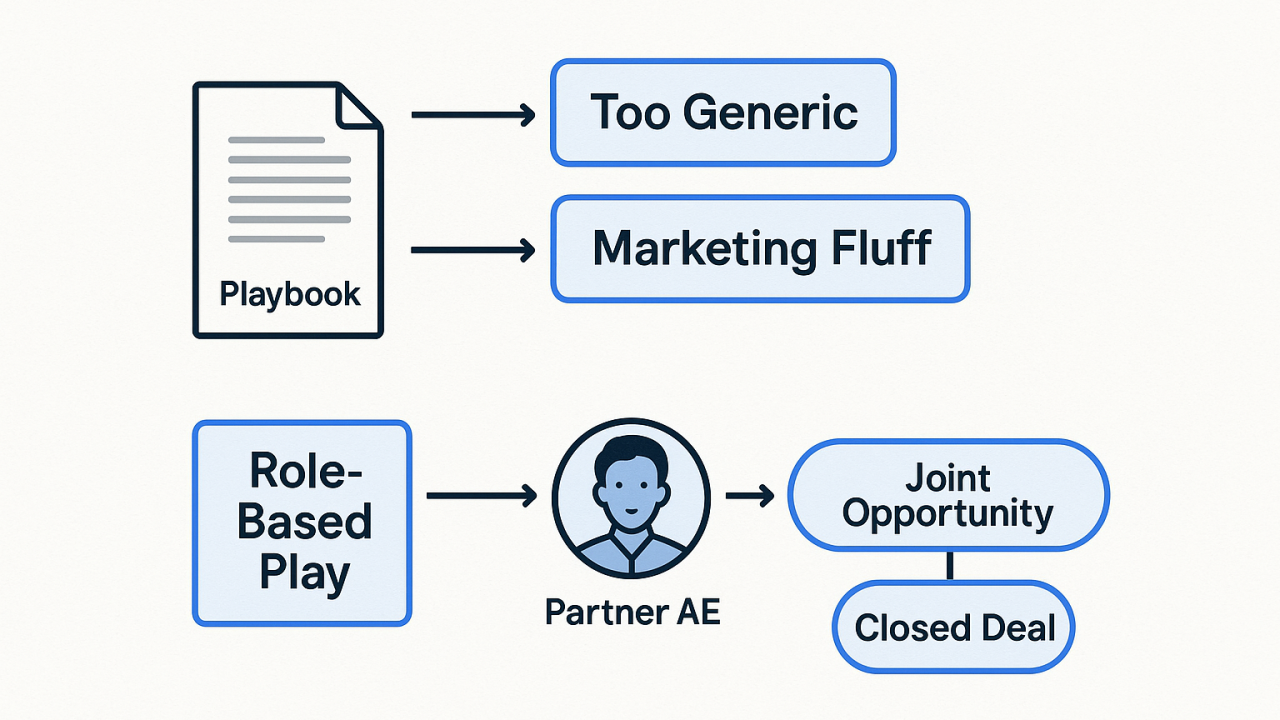
That’s rarely a motivation problem. It’s almost always a usability problem. Most playbooks fail not because partners or sellers don’t care, but because the content doesn’t help them move a deal forward in real time.
Here’s where things usually break—and how to fix them.
You built a partner playbook.
You launched it.
You might have even trained on it.
And still—no one uses it.
That’s rarely a motivation problem. It’s almost always a usability problem. Most playbooks fail not because partners or sellers don’t care, but because the content doesn’t help them move a deal forward in real time.
Here’s where things usually break—and how to fix them.
1. The playbook is too complex or too shallow
Most playbooks fall into one of two extremes. They’re either encyclopedic—dozens of slides, dense frameworks, abstract positioning—or they’re so high-level they add no value beyond what sellers already know. In both cases, the outcome is the same: the content gets ignored.
Sellers don’t want a content library. They want a shortcut. Something that helps them say the right thing, to the right person, at the right moment.
Fix it: Break the playbook into modular, role-based plays tied to specific sales moments—prospecting, discovery, objections, expansion. Make it explicit what to say, when to say it, and why it matters. If it doesn’t change a conversation, it doesn’t belong.
2. The content isn’t situational
Most playbooks are written for “a partner” selling into “a vertical.” That’s not how deals work. Real conversations involve specific personas, internal politics, timing pressure, and objections that don’t fit neatly into broad messaging.
Sellers don’t think in frameworks. They think in scenarios.
Fix it: Anchor each play to a clear motion: who the buyer is, why this partner is relevant, when to introduce them, and what problem they solve in that moment. If the content doesn’t help in a live call, it won’t get used.
3. The playbook isn’t where sellers work
Even strong content fails if it’s buried across portals, shared drives, wikis, and enablement tools. Sellers already juggle too many systems. If they have to hunt for guidance, they won’t.
Fix it: Deliver plays where sellers already operate—short decks, one-pagers, Slack posts, deal-room links, or embedded sales tools. Format and access matter as much as the message.
The takeaway
Playbooks don’t fail because people don’t care. They fail because they’re built as artifacts instead of tools. When enablement is clear, contextual, accessible, and aligned to real co-sell motions, adoption follows—and pipeline does too.
If your playbook isn’t being used, the answer isn’t more training. It’s better design.
The Blame Game That’s Stalling Your Ecosystem
Partner Account Managers are burned out—and ecosystems are stalling. But before more enablement decks get thrown at the problem, let’s be clear: this isn’t a PAM failure.
It’s a design failure.
Partner Account Managers are burned out—and ecosystems are stalling. But before more enablement decks get thrown at the problem, let’s be clear: this isn’t a PAM failure.
It’s a design failure.
Enterprise SaaS vendors love to talk about ecosystem scale—long-tail activation, co-sell at scale, leverage through partners. But behind the ambition sits a system that quietly sets partner managers up to lose.
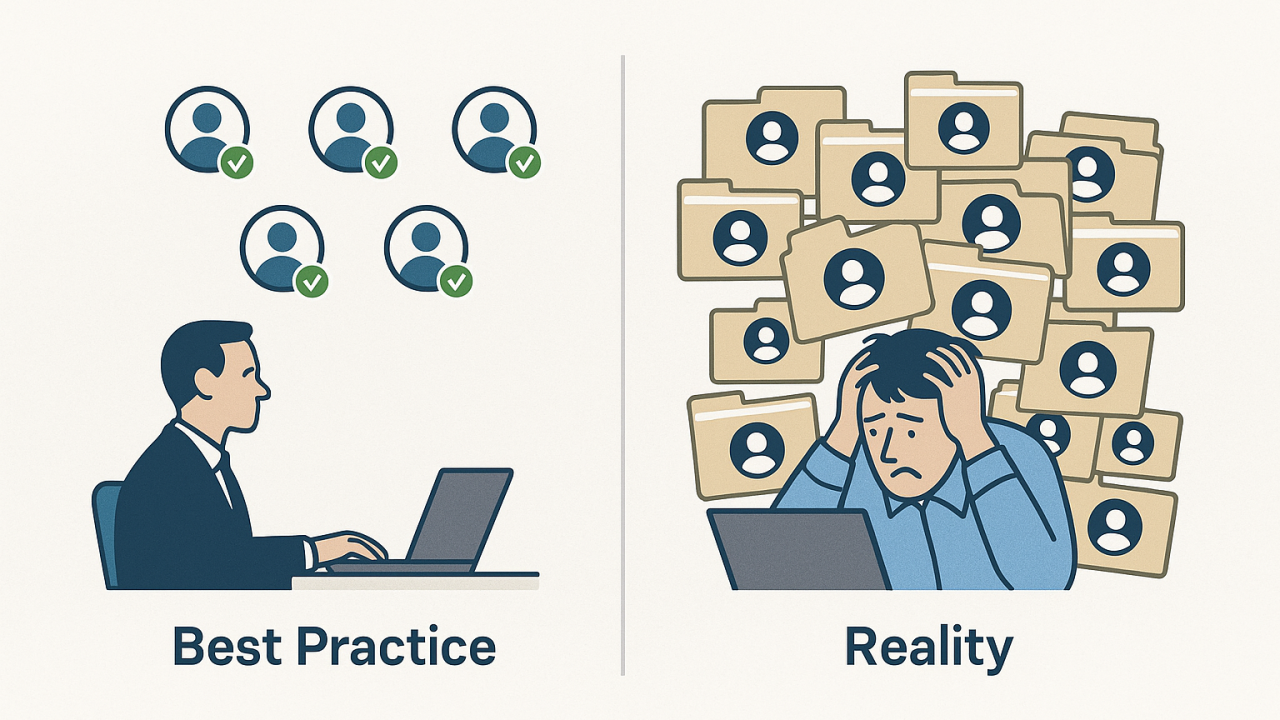
On paper, the role is clear. PAMs are expected to manage strategic relationships, drive joint GTM execution, support the field, recruit and onboard new partners, and track partner-sourced pipeline. Best practice suggests one PAM can meaningfully manage five to seven partners. Maybe one or two large GSIs.
Reality looks very different. Most PAMs today carry forty to one hundred partners. That isn’t partnership management. It’s survival mode.
When partner teams describe how time is actually spent, the picture is consistent: reacting to one-off partner requests, navigating internal silos for basic answers, logging activity into underused PRMs, and repeatedly pointing partners to the same buried assets. Meanwhile, engagement with the tools meant to support them remains low, content goes stale, and visibility into partner readiness is minimal.
This isn’t because PAMs lack effort or capability. It’s because the system rewards noise over impact. While managers drown in operational churn, high-potential partners are left guessing how to win.
Calling this a talent issue misses the point. Most PAMs—especially early in their careers—come from sales or support backgrounds. They’re connectors. But the partners they’re assigned to manage, particularly in the long tail, need strategy, packaging, and GTM activation. Not just introductions.
The economics make the gap worse. A fully loaded PAM costs roughly $180K–$220K per year. Spread across dozens of partners, that translates to a few thousand dollars of attention per partner annually—barely enough for triage, let alone growth.
In many ecosystems, the most vulnerable partners are assigned to the least experienced managers. Not because those managers aren’t capable, but because they’re still learning the role themselves. Vendors then misread stalled progress as partner underperformance, when it’s really a support gap embedded in the model.
The path forward isn’t more headcount. It’s structural change.
Ecosystems that perform at scale treat partner development as an operating discipline. They recruit with intent, package sales plays partners can actually execute, focus enablement on first-deal outcomes, and give the field clear guidance on when and how to engage. Performance is measured at the cohort level, creating visibility without burning out individuals.
In that model, PAMs aren’t expected to carry strategic GTM alone. The system does more of the work, extending their reach instead of draining it.
If your partner managers are buried under dozens of accounts, outdated tools, and reactive work, they’ll never have space to drive real growth. The fix isn’t trying harder. It’s building a model that makes success possible in the first place.

Why Your Ecosystem Strategy Is Leaving Millions on the Table
Enterprise SaaS companies love to point to the scale of their ecosystems—and for good reason. The numbers are impressive. Salesforce projects its partner economy will generate well over a trillion dollars in economic impact. Microsoft, AWS, and ServiceNow report similar multipliers, where every dollar of platform revenue drives many more through services, integrations, and partner-led work.
Enterprise SaaS companies love to point to the scale of their ecosystems—and for good reason. The numbers are impressive. Salesforce projects its partner economy will generate well over a trillion dollars in economic impact. Microsoft, AWS, and ServiceNow report similar multipliers, where every dollar of platform revenue drives many more through services, integrations, and partner-led work.
Ecosystems work. That part isn’t in question.
What rarely gets discussed is where that impact actually comes from. In most cases, it’s driven by a small, elite portion of the partner base. The rest—certified, trained, technically aligned—operate largely on their own.
Despite having thousands of partners, most large ecosystems provide consistent, hands-on support to only a fraction of them. Everyone else relies on portals, automated onboarding, and the occasional campaign. Across Salesforce, Microsoft, AWS, and ServiceNow, the pattern is the same: partners are “in” the ecosystem, but not meaningfully activated within it.
For many partners, that reality becomes clear quickly. They’re listed and credentialed, but there’s no obvious path to their first deal. No consistent introductions. No clear guidance on how to engage the field. Over time, effort shifts elsewhere—not out of frustration, but pragmatism.
This isn’t neglect. It’s math.
Partner teams are stretched thin. A single partner manager often supports dozens of accounts, far beyond what effective engagement allows. Expanding headcount isn’t economically viable, especially when partner-sourced revenue is difficult to attribute cleanly. So ecosystems default to what feels efficient: doubling down on the top performers and letting the rest fade into the background.
That’s where the real opportunity gets missed.
The mid-tier of most ecosystems is not low quality—it’s under-supported. These partners are often deeply embedded in specific regions, industries, or use cases that internal teams can’t cover at scale. They have customer trust and technical capability, but lack clarity on which motions to run, how to engage sellers, and how to reach their first wins.
They don’t need white-glove treatment. They need structure.
When mid-tier partners are given clear plays, defined engagement paths, and consistent expectations, they move. Not all of them—but enough to materially change coverage, pipeline, and long-term growth. This is the most scalable layer of the ecosystem, precisely because it already exists.
Every ecosystem will always have a top 10%. Those partners matter. But scale doesn’t come from concentrating effort where results already exist. It comes from activating the large, capable middle that has been overlooked—not because it lacks potential, but because the system was never designed to support it.
They don’t need a red carpet.
They need a roadmap.
You Built the Ecosystem. But Did You Build the Experience?
In a 2023 survey of global technology ecosystems, more than 70% of partners reported disengaging from at least one vendor due to unclear co-selling paths or weak enablement. One high-performing systems integrator described their exit from a large SaaS partner program this way: they had the certifications and references, but AE alignment was inconsistent, partner ownership changed repeatedly, and co-sell opportunities went nowhere. Eventually, they stopped trying.
Your partner dashboards look healthy.
Your tiers are clearly defined.
Your QBRs show activity.
Yet the revenue doesn’t reflect the investment. And your highest-potential partners aren’t raising concerns. They’re simply not raising deals either.
This is the silent churn most SaaS ecosystems miss—and it quietly drains pipeline.
In a 2023 survey of global technology ecosystems, more than 70% of partners reported disengaging from at least one vendor due to unclear co-selling paths or weak enablement. One high-performing systems integrator described their exit from a large SaaS partner program this way: they had the certifications and references, but AE alignment was inconsistent, partner ownership changed repeatedly, and co-sell opportunities went nowhere. Eventually, they stopped trying.
They didn’t leave because the strategy was flawed. They left because the experience was.
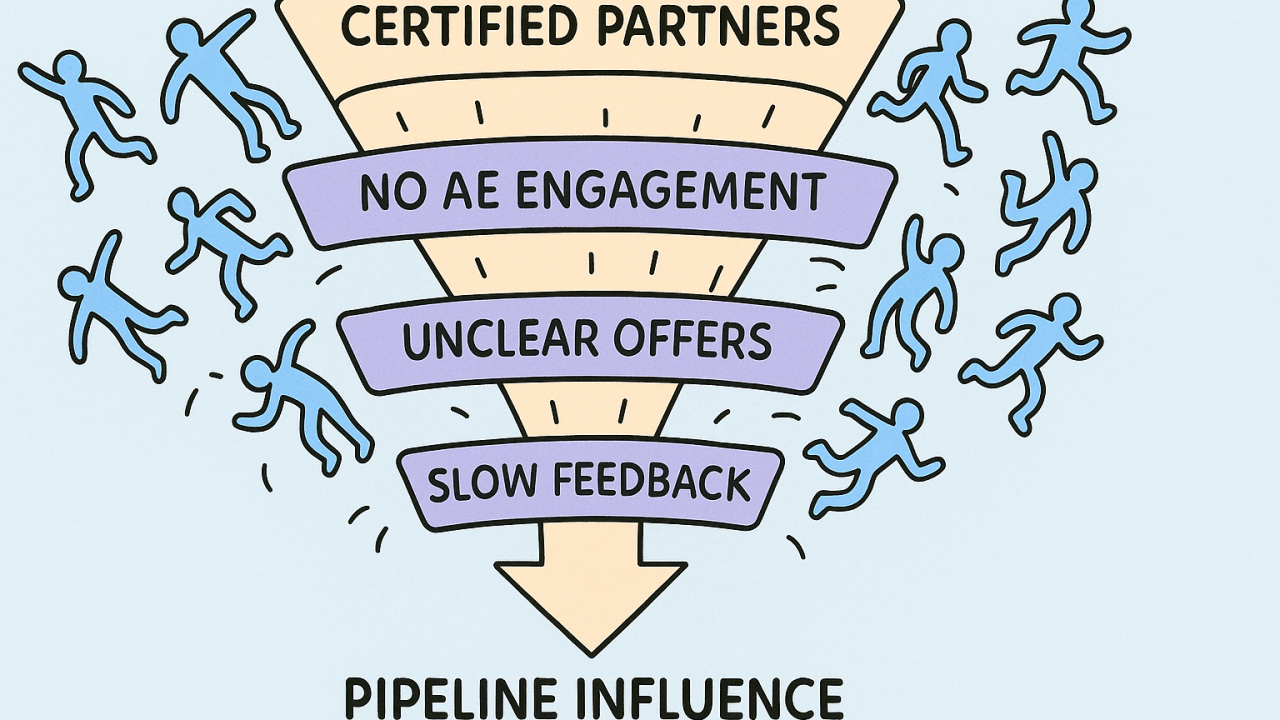
Most partner churn isn’t an active decision. It’s a reallocation of attention. Partners gravitate toward ecosystems where it’s easier to win. Today, many report no clear path to value, little evidence their feedback is acted on, and limited readiness to co-sell despite being fully credentialed. On paper, they look enabled. In practice, they’re stuck navigating friction.
That friction usually shows up in familiar ways: no packaged offers to bring to market, uneven AE engagement across teams, slow approvals for joint activity, and minimal follow-up after partner-initiated introductions. Internally, this reads as inactivity. From the partner’s perspective, it feels like a relationship that isn’t worth betting on.
Most ecosystems don’t suffer from a strategy problem. They suffer from a user experience problem.
Partner leaders spend months refining tiers, KPIs, and portal functionality, yet few ever walk through the ecosystem the way a partner does. Imagine asking a sales hire to succeed without onboarding, a clear playbook, or consistent support. That’s the reality many partners face every day.
High-performing ecosystems don’t confuse experience with perks or engagement metrics. They focus on performance-driven design: fast onboarding aligned to real GTM motions, clear offers tied to use cases, consistent AE involvement, and feedback loops after live deals. Research shows ecosystems that prioritize partner experience materially outperform peers in influenced revenue.
When partners disengage quietly, the issue is rarely motivation or capability. More often, it’s friction, ambiguity, and misalignment embedded in the system itself. Fix the experience, and the right partners don’t need to be chased—they re-engage on their own.
The Illusion of Co-Sell Is Killing Your Ecosystem
Enterprise SaaS partner programs have scaled rapidly—thousands of partners, millions invested, endless reporting on engagement. But at the deal level, reality looks different. Co-sell often happens too late, if it happens at all. “Influence” usually means proximity, not contribution. Leadership sees partner-led growth. Sales sees friction. Partners don’t know when or how to engage. Everyone is staring at the same data and walking away with different conclusions.
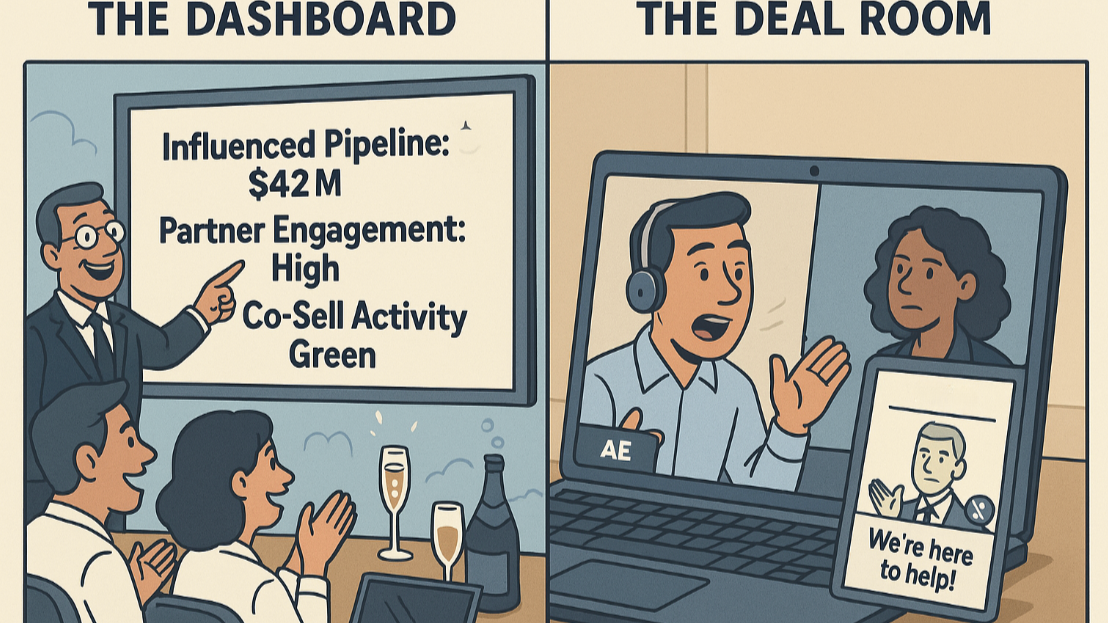
Your dashboards say partners are engaged.
Your portal shows activity.
Your QBRs cite “influence.”
But when you trace the deal, a familiar pattern appears.
The AE sourced it.
The AE ran it.
The AE closed it.
The partner may have added a slide or registered the deal after the fact, but they didn’t shape the outcome. That’s not co-sell. It’s theater. And it’s quietly eroding trust across your ecosystem.
Enterprise SaaS partner programs have scaled rapidly—thousands of partners, millions invested, endless reporting on engagement. But at the deal level, reality looks different. Co-sell often happens too late, if it happens at all. “Influence” usually means proximity, not contribution. Leadership sees partner-led growth. Sales sees friction. Partners don’t know when or how to engage. Everyone is staring at the same data and walking away with different conclusions.
This disconnect exists because selling is treated as an afterthought in partner strategy.
Partner-led growth does work—but only when it’s designed for how deals actually move. Real co-sell requires clarity: defined ICPs, focused use cases, and shared expectations from first conversation to close. Partners need to know where they add value. AEs need to trust that bringing a partner in will help, not slow them down. None of that comes from a portal login or a certification badge. It comes from structure.
Most co-sell motions fail for three reasons. First, teams track noise instead of signal. Deal registration is mistaken for impact. Slides are confused with acceleration. If sourced, accelerated, and expanded deals aren’t measured distinctly, co-sell performance remains invisible. Second, many partners aren’t sales-ready. They understand the product but not the motion. They need plays, not pitch decks. Third, AEs disengage. Too many partner introductions have led to vague positioning, misalignment, or stalled momentum—and once trust is lost, invitations stop.
The ecosystems that perform consistently don’t treat co-sell as a checkbox. They engineer partners directly into the sales motion. That means clear expectations, early involvement, and metrics that reflect contribution—not appearances. It also means feedback loops that refine what works and retire what doesn’t.
If your partner strategy looks strong in slides but flatlines in Salesforce, the issue isn’t your ecosystem. It’s the co-sell motion underneath it. Until that’s built for reality, performance will always lag perception.

When Partner Programs Launch—but Never Scale
A few years ago, Asana invested heavily in expanding its partner ecosystem. The company refreshed its program, introduced co-marketing resources, and rolled out incentives designed to encourage co-selling. On paper, it was a strong move. But within a year, momentum slowed. Partners were technically enabled, yet pipeline never materialized at scale. Sales teams weren’t consistently pulling partners into deals, and most partners weren’t sourcing opportunities on their own.
A few years ago, Asana invested heavily in expanding its partner ecosystem. The company refreshed its program, introduced co-marketing resources, and rolled out incentives designed to encourage co-selling. On paper, it was a strong move. But within a year, momentum slowed. Partners were technically enabled, yet pipeline never materialized at scale. Sales teams weren’t consistently pulling partners into deals, and most partners weren’t sourcing opportunities on their own.
This isn’t unique to Asana. It’s a pattern that shows up repeatedly in fast-growing SaaS ecosystems: partner strategies that are designed to launch, but not to last.
The early phase usually looks promising. The right partners are recruited. Tiers are defined. Assets are created. A handful of early wins validate the direction. Then the motion stalls. Sales attention drifts back to direct deals. Partners disengage quietly. Results plateau without anyone being able to point to a single failure.
The issue isn’t ambition or intent. It’s infrastructure.
Most partner programs are built as initiatives rather than operating systems. They focus on onboarding and enablement without defining how partners actually fit into the day-to-day sales motion. Without a clear go-to-market structure, even well-designed programs struggle to translate potential into pipeline.
The symptoms are easy to spot. Field teams aren’t sure when or why to involve partners. Co-selling is discussed but rarely executed in a repeatable way. A small group of top partners stays engaged while the majority remains inactive. Internal teams—sales, alliances, and marketing—operate in parallel rather than in sync, leaving partners uncertain about where to focus.
None of this is caused by partner quality. It’s a systems problem.
Partner-led growth doesn’t happen passively. It requires intentional motion. Partners need a reason to engage that goes beyond access to a portal or a quarterly newsletter. Sales teams need clarity on how partners accelerate deals rather than slow them down. And leadership needs visibility early enough to see what’s working before momentum fades.
The ecosystems that perform well over time tend to share a few traits. They anchor partner activity to real use cases rather than abstract capabilities. They create structured activation windows that generate movement, not just participation. They equip the field with simple, repeatable ways to bring partners into live opportunities. And they track performance at the motion level, not just at the revenue finish line.
The difference isn’t the size of the partner organization or the number of assets produced. It’s whether the ecosystem is treated as a system that needs rhythm, feedback, and accountability.
Many partner programs don’t fail. They simply stop moving. And in an environment where growth depends on leverage, a stalled ecosystem is often the most expensive problem no one is actively solving.

The Hidden Cost of Focusing Only on Top Partners
In the last few years, major enterprise ecosystems have quietly restructured their partner teams. Salesforce reduced large portions of its alliances function. Microsoft, Red Hat, and others followed similar paths—leaning into automation, self-service, and efficiency while narrowing direct support to a small percentage of top-performing partners.
In the last few years, major enterprise ecosystems have quietly restructured their partner teams. Salesforce reduced large portions of its alliances function. Microsoft, Red Hat, and others followed similar paths—leaning into automation, self-service, and efficiency while narrowing direct support to a small percentage of top-performing partners.
On paper, this makes sense. Partner ecosystems are massive. Resources are finite. Concentrating effort on the partners already driving the most revenue feels rational. But beneath that logic is a growing structural problem that most companies haven’t fully reckoned with.
These ecosystems aren’t short on partners. They’re short on visibility.
Most enterprise platforms have thousands of certified system integrators and ISVs operating across regions, industries, and segments. Many of these partners are active, credentialed, and selling. What they lack isn’t motivation—it’s guidance, structure, and access. When support concentrates around the top 5–10%, the remaining majority quietly slips into the background.
The cost of that neglect rarely shows up immediately. Instead, it surfaces as silent churn, inconsistent market coverage, and pipeline that never quite materializes. Partners don’t fail loudly. They disengage gradually, redirecting their energy toward ecosystems where the path to impact is clearer.
This misalignment between resources and revenue potential has become the norm. Partner teams face tightening budgets, increased pressure for attribution, and growing expectations to “scale with less.” The result is a model optimized for maintaining existing performance rather than uncovering new sources of growth.
Yet ecosystems have changed. Influence is no longer concentrated at the top. Mid-tier and long-tail partners often bring net-new logos, regional access, and deep vertical specialization that larger partners simply don’t prioritize. When these partners are left unsegmented and unsupported, their potential remains invisible.
The barriers to activation aren’t philosophical—they’re operational. Partner managers routinely carry dozens of accounts, making meaningful engagement with the long tail unrealistic. Without clear segmentation, most partners receive the same generic communications regardless of readiness or opportunity. And without consistent tracking, it’s nearly impossible to connect partner activity to downstream revenue.
What gets missed in this model is that partner performance isn’t static. With structure, accountability, and feedback loops, previously dormant partners can become meaningful contributors—sometimes faster than expected. The difference isn’t talent. It’s incubation.
The next phase of partner-led growth won’t come from adding more partners or building bigger portals. It will come from treating the middle of the ecosystem as a system to be managed, not a backlog to be ignored. Companies that figure out how to surface, enable, and measure this hidden layer will expand coverage, reduce churn, and unlock revenue that has been sitting in plain sight all along.