The Blame Game That’s Stalling Your Ecosystem
Partner Account Managers are burned out—and ecosystems are stalling. But before more enablement decks get thrown at the problem, let’s be clear: this isn’t a PAM failure.
It’s a design failure.
Partner Account Managers are burned out—and ecosystems are stalling. But before more enablement decks get thrown at the problem, let’s be clear: this isn’t a PAM failure.
It’s a design failure.
Enterprise SaaS vendors love to talk about ecosystem scale—long-tail activation, co-sell at scale, leverage through partners. But behind the ambition sits a system that quietly sets partner managers up to lose.
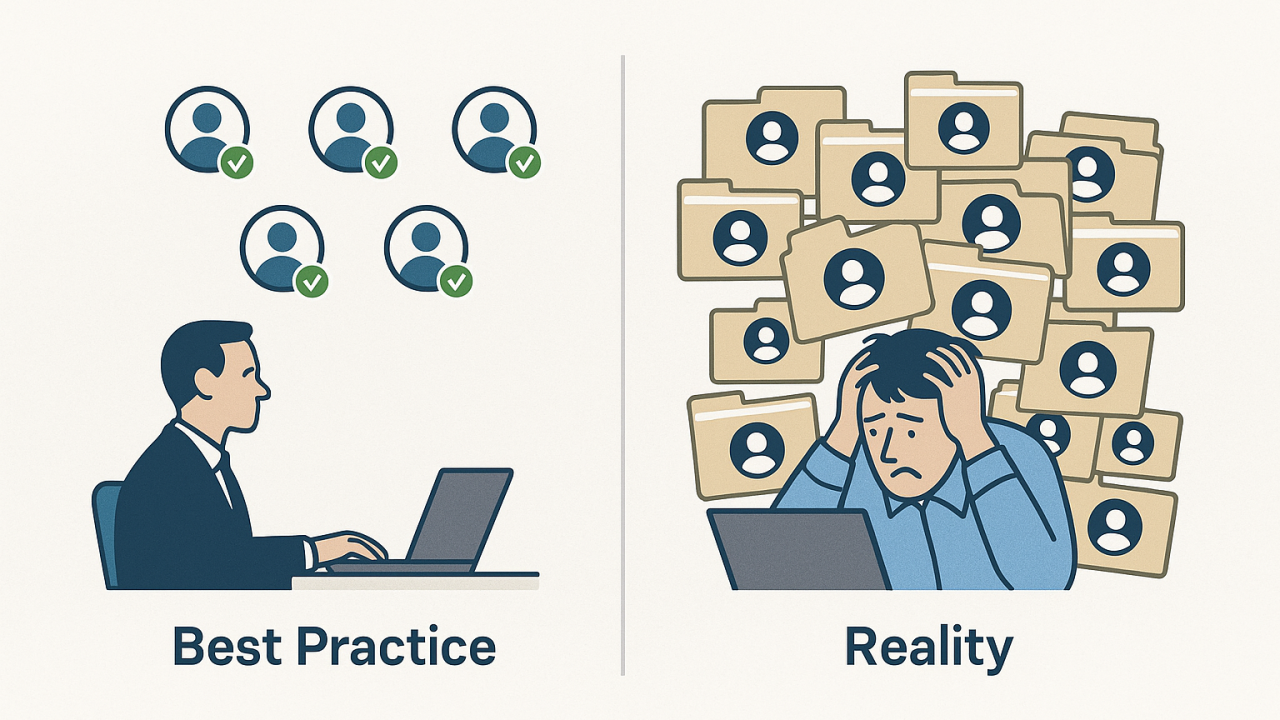
On paper, the role is clear. PAMs are expected to manage strategic relationships, drive joint GTM execution, support the field, recruit and onboard new partners, and track partner-sourced pipeline. Best practice suggests one PAM can meaningfully manage five to seven partners. Maybe one or two large GSIs.
Reality looks very different. Most PAMs today carry forty to one hundred partners. That isn’t partnership management. It’s survival mode.
When partner teams describe how time is actually spent, the picture is consistent: reacting to one-off partner requests, navigating internal silos for basic answers, logging activity into underused PRMs, and repeatedly pointing partners to the same buried assets. Meanwhile, engagement with the tools meant to support them remains low, content goes stale, and visibility into partner readiness is minimal.
This isn’t because PAMs lack effort or capability. It’s because the system rewards noise over impact. While managers drown in operational churn, high-potential partners are left guessing how to win.
Calling this a talent issue misses the point. Most PAMs—especially early in their careers—come from sales or support backgrounds. They’re connectors. But the partners they’re assigned to manage, particularly in the long tail, need strategy, packaging, and GTM activation. Not just introductions.
The economics make the gap worse. A fully loaded PAM costs roughly $180K–$220K per year. Spread across dozens of partners, that translates to a few thousand dollars of attention per partner annually—barely enough for triage, let alone growth.
In many ecosystems, the most vulnerable partners are assigned to the least experienced managers. Not because those managers aren’t capable, but because they’re still learning the role themselves. Vendors then misread stalled progress as partner underperformance, when it’s really a support gap embedded in the model.
The path forward isn’t more headcount. It’s structural change.
Ecosystems that perform at scale treat partner development as an operating discipline. They recruit with intent, package sales plays partners can actually execute, focus enablement on first-deal outcomes, and give the field clear guidance on when and how to engage. Performance is measured at the cohort level, creating visibility without burning out individuals.
In that model, PAMs aren’t expected to carry strategic GTM alone. The system does more of the work, extending their reach instead of draining it.
If your partner managers are buried under dozens of accounts, outdated tools, and reactive work, they’ll never have space to drive real growth. The fix isn’t trying harder. It’s building a model that makes success possible in the first place.

Why Your Ecosystem Strategy Is Leaving Millions on the Table
Enterprise SaaS companies love to point to the scale of their ecosystems—and for good reason. The numbers are impressive. Salesforce projects its partner economy will generate well over a trillion dollars in economic impact. Microsoft, AWS, and ServiceNow report similar multipliers, where every dollar of platform revenue drives many more through services, integrations, and partner-led work.
Enterprise SaaS companies love to point to the scale of their ecosystems—and for good reason. The numbers are impressive. Salesforce projects its partner economy will generate well over a trillion dollars in economic impact. Microsoft, AWS, and ServiceNow report similar multipliers, where every dollar of platform revenue drives many more through services, integrations, and partner-led work.
Ecosystems work. That part isn’t in question.
What rarely gets discussed is where that impact actually comes from. In most cases, it’s driven by a small, elite portion of the partner base. The rest—certified, trained, technically aligned—operate largely on their own.
Despite having thousands of partners, most large ecosystems provide consistent, hands-on support to only a fraction of them. Everyone else relies on portals, automated onboarding, and the occasional campaign. Across Salesforce, Microsoft, AWS, and ServiceNow, the pattern is the same: partners are “in” the ecosystem, but not meaningfully activated within it.
For many partners, that reality becomes clear quickly. They’re listed and credentialed, but there’s no obvious path to their first deal. No consistent introductions. No clear guidance on how to engage the field. Over time, effort shifts elsewhere—not out of frustration, but pragmatism.
This isn’t neglect. It’s math.
Partner teams are stretched thin. A single partner manager often supports dozens of accounts, far beyond what effective engagement allows. Expanding headcount isn’t economically viable, especially when partner-sourced revenue is difficult to attribute cleanly. So ecosystems default to what feels efficient: doubling down on the top performers and letting the rest fade into the background.
That’s where the real opportunity gets missed.
The mid-tier of most ecosystems is not low quality—it’s under-supported. These partners are often deeply embedded in specific regions, industries, or use cases that internal teams can’t cover at scale. They have customer trust and technical capability, but lack clarity on which motions to run, how to engage sellers, and how to reach their first wins.
They don’t need white-glove treatment. They need structure.
When mid-tier partners are given clear plays, defined engagement paths, and consistent expectations, they move. Not all of them—but enough to materially change coverage, pipeline, and long-term growth. This is the most scalable layer of the ecosystem, precisely because it already exists.
Every ecosystem will always have a top 10%. Those partners matter. But scale doesn’t come from concentrating effort where results already exist. It comes from activating the large, capable middle that has been overlooked—not because it lacks potential, but because the system was never designed to support it.
They don’t need a red carpet.
They need a roadmap.
You Built the Ecosystem. But Did You Build the Experience?
In a 2023 survey of global technology ecosystems, more than 70% of partners reported disengaging from at least one vendor due to unclear co-selling paths or weak enablement. One high-performing systems integrator described their exit from a large SaaS partner program this way: they had the certifications and references, but AE alignment was inconsistent, partner ownership changed repeatedly, and co-sell opportunities went nowhere. Eventually, they stopped trying.
Your partner dashboards look healthy.
Your tiers are clearly defined.
Your QBRs show activity.
Yet the revenue doesn’t reflect the investment. And your highest-potential partners aren’t raising concerns. They’re simply not raising deals either.
This is the silent churn most SaaS ecosystems miss—and it quietly drains pipeline.
In a 2023 survey of global technology ecosystems, more than 70% of partners reported disengaging from at least one vendor due to unclear co-selling paths or weak enablement. One high-performing systems integrator described their exit from a large SaaS partner program this way: they had the certifications and references, but AE alignment was inconsistent, partner ownership changed repeatedly, and co-sell opportunities went nowhere. Eventually, they stopped trying.
They didn’t leave because the strategy was flawed. They left because the experience was.
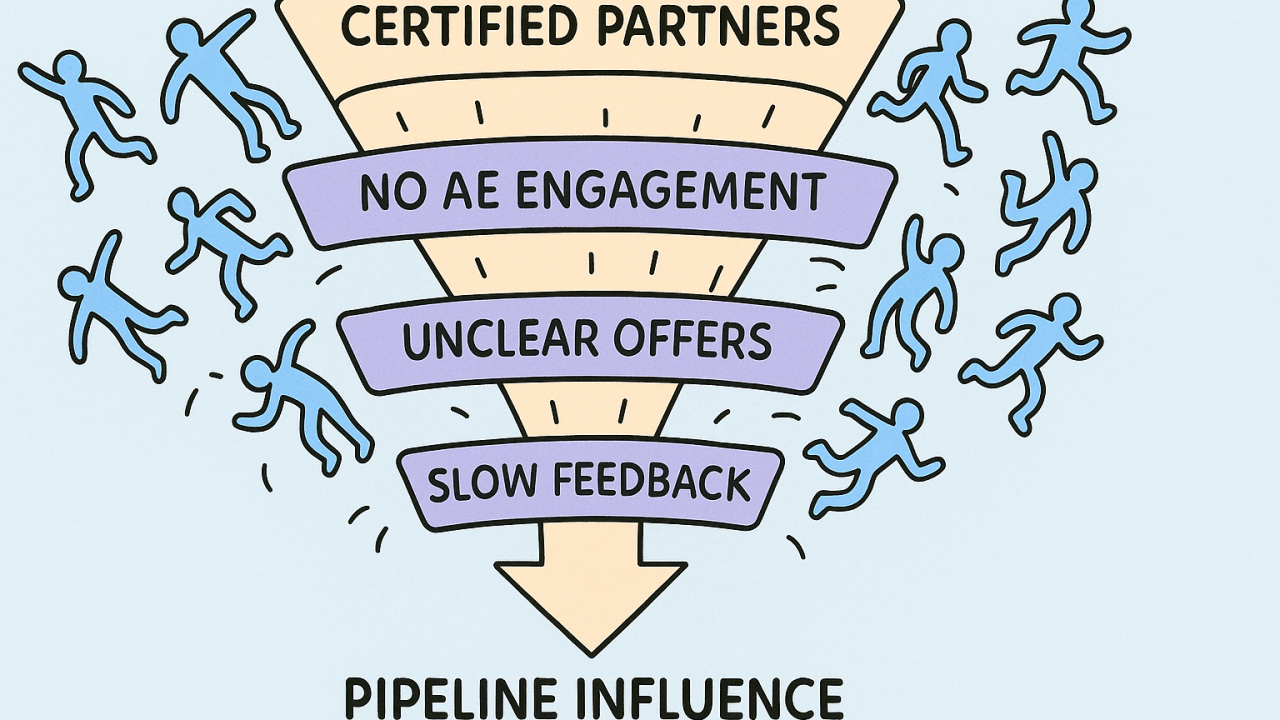
Most partner churn isn’t an active decision. It’s a reallocation of attention. Partners gravitate toward ecosystems where it’s easier to win. Today, many report no clear path to value, little evidence their feedback is acted on, and limited readiness to co-sell despite being fully credentialed. On paper, they look enabled. In practice, they’re stuck navigating friction.
That friction usually shows up in familiar ways: no packaged offers to bring to market, uneven AE engagement across teams, slow approvals for joint activity, and minimal follow-up after partner-initiated introductions. Internally, this reads as inactivity. From the partner’s perspective, it feels like a relationship that isn’t worth betting on.
Most ecosystems don’t suffer from a strategy problem. They suffer from a user experience problem.
Partner leaders spend months refining tiers, KPIs, and portal functionality, yet few ever walk through the ecosystem the way a partner does. Imagine asking a sales hire to succeed without onboarding, a clear playbook, or consistent support. That’s the reality many partners face every day.
High-performing ecosystems don’t confuse experience with perks or engagement metrics. They focus on performance-driven design: fast onboarding aligned to real GTM motions, clear offers tied to use cases, consistent AE involvement, and feedback loops after live deals. Research shows ecosystems that prioritize partner experience materially outperform peers in influenced revenue.
When partners disengage quietly, the issue is rarely motivation or capability. More often, it’s friction, ambiguity, and misalignment embedded in the system itself. Fix the experience, and the right partners don’t need to be chased—they re-engage on their own.
The Illusion of Co-Sell Is Killing Your Ecosystem
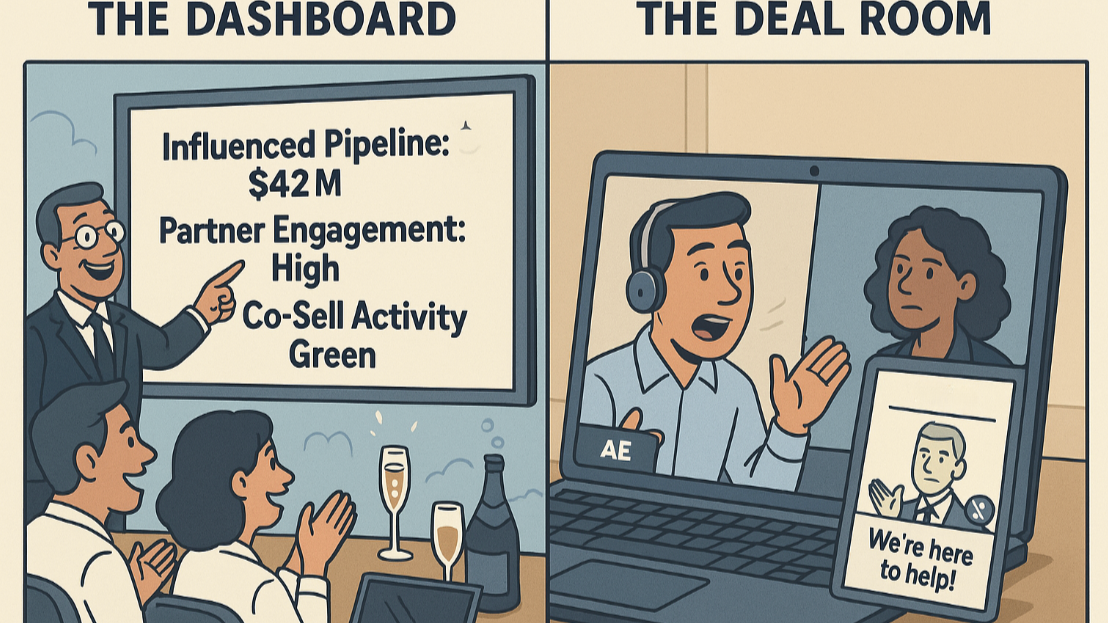
Enterprise SaaS partner programs have scaled rapidly—thousands of partners, millions invested, endless reporting on engagement. But at the deal level, reality looks different. Co-sell often happens too late, if it happens at all. “Influence” usually means proximity, not contribution. Leadership sees partner-led growth. Sales sees friction. Partners don’t know when or how to engage. Everyone is staring at the same data and walking away with different conclusions.
Your dashboards say partners are engaged.
Your portal shows activity.
Your QBRs cite “influence.”
But when you trace the deal, a familiar pattern appears.
The AE sourced it.
The AE ran it.
The AE closed it.
The partner may have added a slide or registered the deal after the fact, but they didn’t shape the outcome. That’s not co-sell. It’s theater. And it’s quietly eroding trust across your ecosystem.
Enterprise SaaS partner programs have scaled rapidly—thousands of partners, millions invested, endless reporting on engagement. But at the deal level, reality looks different. Co-sell often happens too late, if it happens at all. “Influence” usually means proximity, not contribution. Leadership sees partner-led growth. Sales sees friction. Partners don’t know when or how to engage. Everyone is staring at the same data and walking away with different conclusions.
This disconnect exists because selling is treated as an afterthought in partner strategy.
Partner-led growth does work—but only when it’s designed for how deals actually move. Real co-sell requires clarity: defined ICPs, focused use cases, and shared expectations from first conversation to close. Partners need to know where they add value. AEs need to trust that bringing a partner in will help, not slow them down. None of that comes from a portal login or a certification badge. It comes from structure.
Most co-sell motions fail for three reasons. First, teams track noise instead of signal. Deal registration is mistaken for impact. Slides are confused with acceleration. If sourced, accelerated, and expanded deals aren’t measured distinctly, co-sell performance remains invisible. Second, many partners aren’t sales-ready. They understand the product but not the motion. They need plays, not pitch decks. Third, AEs disengage. Too many partner introductions have led to vague positioning, misalignment, or stalled momentum—and once trust is lost, invitations stop.
The ecosystems that perform consistently don’t treat co-sell as a checkbox. They engineer partners directly into the sales motion. That means clear expectations, early involvement, and metrics that reflect contribution—not appearances. It also means feedback loops that refine what works and retire what doesn’t.
If your partner strategy looks strong in slides but flatlines in Salesforce, the issue isn’t your ecosystem. It’s the co-sell motion underneath it. Until that’s built for reality, performance will always lag perception.

When Partner Programs Launch—but Never Scale
A few years ago, Asana invested heavily in expanding its partner ecosystem. The company refreshed its program, introduced co-marketing resources, and rolled out incentives designed to encourage co-selling. On paper, it was a strong move. But within a year, momentum slowed. Partners were technically enabled, yet pipeline never materialized at scale. Sales teams weren’t consistently pulling partners into deals, and most partners weren’t sourcing opportunities on their own.
A few years ago, Asana invested heavily in expanding its partner ecosystem. The company refreshed its program, introduced co-marketing resources, and rolled out incentives designed to encourage co-selling. On paper, it was a strong move. But within a year, momentum slowed. Partners were technically enabled, yet pipeline never materialized at scale. Sales teams weren’t consistently pulling partners into deals, and most partners weren’t sourcing opportunities on their own.
This isn’t unique to Asana. It’s a pattern that shows up repeatedly in fast-growing SaaS ecosystems: partner strategies that are designed to launch, but not to last.
The early phase usually looks promising. The right partners are recruited. Tiers are defined. Assets are created. A handful of early wins validate the direction. Then the motion stalls. Sales attention drifts back to direct deals. Partners disengage quietly. Results plateau without anyone being able to point to a single failure.
The issue isn’t ambition or intent. It’s infrastructure.
Most partner programs are built as initiatives rather than operating systems. They focus on onboarding and enablement without defining how partners actually fit into the day-to-day sales motion. Without a clear go-to-market structure, even well-designed programs struggle to translate potential into pipeline.
The symptoms are easy to spot. Field teams aren’t sure when or why to involve partners. Co-selling is discussed but rarely executed in a repeatable way. A small group of top partners stays engaged while the majority remains inactive. Internal teams—sales, alliances, and marketing—operate in parallel rather than in sync, leaving partners uncertain about where to focus.
None of this is caused by partner quality. It’s a systems problem.
Partner-led growth doesn’t happen passively. It requires intentional motion. Partners need a reason to engage that goes beyond access to a portal or a quarterly newsletter. Sales teams need clarity on how partners accelerate deals rather than slow them down. And leadership needs visibility early enough to see what’s working before momentum fades.
The ecosystems that perform well over time tend to share a few traits. They anchor partner activity to real use cases rather than abstract capabilities. They create structured activation windows that generate movement, not just participation. They equip the field with simple, repeatable ways to bring partners into live opportunities. And they track performance at the motion level, not just at the revenue finish line.
The difference isn’t the size of the partner organization or the number of assets produced. It’s whether the ecosystem is treated as a system that needs rhythm, feedback, and accountability.
Many partner programs don’t fail. They simply stop moving. And in an environment where growth depends on leverage, a stalled ecosystem is often the most expensive problem no one is actively solving.

The Hidden Cost of Focusing Only on Top Partners
In the last few years, major enterprise ecosystems have quietly restructured their partner teams. Salesforce reduced large portions of its alliances function. Microsoft, Red Hat, and others followed similar paths—leaning into automation, self-service, and efficiency while narrowing direct support to a small percentage of top-performing partners.
In the last few years, major enterprise ecosystems have quietly restructured their partner teams. Salesforce reduced large portions of its alliances function. Microsoft, Red Hat, and others followed similar paths—leaning into automation, self-service, and efficiency while narrowing direct support to a small percentage of top-performing partners.
On paper, this makes sense. Partner ecosystems are massive. Resources are finite. Concentrating effort on the partners already driving the most revenue feels rational. But beneath that logic is a growing structural problem that most companies haven’t fully reckoned with.
These ecosystems aren’t short on partners. They’re short on visibility.
Most enterprise platforms have thousands of certified system integrators and ISVs operating across regions, industries, and segments. Many of these partners are active, credentialed, and selling. What they lack isn’t motivation—it’s guidance, structure, and access. When support concentrates around the top 5–10%, the remaining majority quietly slips into the background.
The cost of that neglect rarely shows up immediately. Instead, it surfaces as silent churn, inconsistent market coverage, and pipeline that never quite materializes. Partners don’t fail loudly. They disengage gradually, redirecting their energy toward ecosystems where the path to impact is clearer.
This misalignment between resources and revenue potential has become the norm. Partner teams face tightening budgets, increased pressure for attribution, and growing expectations to “scale with less.” The result is a model optimized for maintaining existing performance rather than uncovering new sources of growth.
Yet ecosystems have changed. Influence is no longer concentrated at the top. Mid-tier and long-tail partners often bring net-new logos, regional access, and deep vertical specialization that larger partners simply don’t prioritize. When these partners are left unsegmented and unsupported, their potential remains invisible.
The barriers to activation aren’t philosophical—they’re operational. Partner managers routinely carry dozens of accounts, making meaningful engagement with the long tail unrealistic. Without clear segmentation, most partners receive the same generic communications regardless of readiness or opportunity. And without consistent tracking, it’s nearly impossible to connect partner activity to downstream revenue.
What gets missed in this model is that partner performance isn’t static. With structure, accountability, and feedback loops, previously dormant partners can become meaningful contributors—sometimes faster than expected. The difference isn’t talent. It’s incubation.
The next phase of partner-led growth won’t come from adding more partners or building bigger portals. It will come from treating the middle of the ecosystem as a system to be managed, not a backlog to be ignored. Companies that figure out how to surface, enable, and measure this hidden layer will expand coverage, reduce churn, and unlock revenue that has been sitting in plain sight all along.